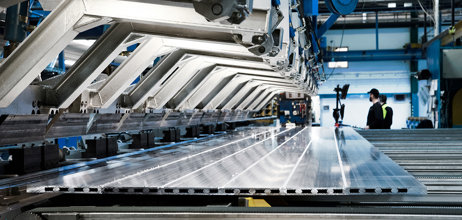
During only the last few years, Hydro has invested in 150 000 tonnes of new recycling capacity in Germany.
Five percent of the energy
One of the benefits of recycling is that it requires only five percent of the energy used to produce new aluminium. In addition, the sources of raw materials are usually close to the market and to one of Hydro's 19 remelting plants. This provides benefits such as reduced transport and has given rise to the term "urban mining."
There is a difference between remelting and recycling. Hydro is already a world leader in the remelting of aluminium, with an annual production of over one million tonnes. This operation includes remelting process scrap - metal that has never been used - from customers and other businesses in the processing industry, as well as from our own facilities.
Strong growth in recycling
Globally, the amount of recycled aluminium grew by 42 percent, from 13.7 million tonnes in 2003 to 19.4 million tonnes in 2009. At the same time, primary metal production increased by 28 percent.
During the same period, growth in recycled scrap from products that have completed their useful life amounted to almost 50 percent.
The latest forecasts from the Aluminium Institute (IAI) predict recycled scrap growing from about 9.5 million tonnes in 2010 to almost 17 million tonnes in 2020.
Changing perceptions
"This trend is driven not only by the dynamics of the market, but by a change in mindsets and attitudes in society," says Roland Scharf-Bergmann, head of Hydro's recycling operations.
"When I started in this business more than 12 years ago, there was still a perception that recycling was in many ways a dirty business," he says.
Attitudes are changing, driven by increased awareness of the environment and the need to conserve energy. Today, reports and statistics present not only scrap collection, recycling rate and production volume, but also "avoided emissions" of CO2 through the recycling of used scrap.
Strategic raw materials
"Scrap has become a strategic raw material. Hydro's role will be to take its share of the market as a leading integrated producer present throughout the value chain. Our position in the market, combined with commercial and technological expertise, will give us growth opportunities in recycling so we can help to reduce environmental emissions," says Scharf-Bergmann.