|
Aluminium ferry ready for regular traffic
 IN OPERATION: "Stavanger", Norways's first aluminium car ferry will operate on the Stavanger - Tau route from 1 June. (Photo: Dag Sunnanå) |
| |
(May 19, 2003) The first aluminium ferry for use in the Norwegian trunk road system was christened in Stavanger on 27 May, and started operation at the beginning of June. The innovative ferry attracted a good deal of attention at Skanaluminium's light metals conference at Solstrand, Os on 14 and 15 May.
The ferry, which was built at the Fjellstrand shipyard at Omastrand in Hardanger, is a Ferrycat 120 type, and will transport up to 108 cars. The shipowner, Stavangerske, will operate the ferry on the Stavanger – Tau route, making this busy crossing considerably more efficient.
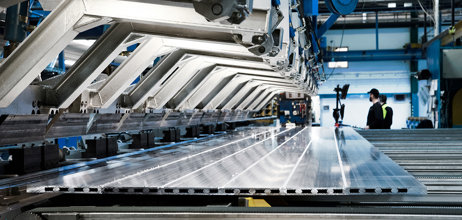
The ferry, which costs nearly NOK 190 million, will have a crew of five. It contains nearly 500 tonnes aluminium, including a good deal of friction welded profiles, one of the main suppliers of which was Hydro Marine Aluminium at Karmøy. The Karmøy company has used this welding method in recent years in a number of deliveries to various ship-building projects, such as the superstructure on cruise ships.
Two similar ferries are under construction at the Fjellstrand shipyard at Omastrand. These will be delivered to Istanbul municipality in the late autumn of 2003 and January 2004 for transport across the Bosphorus Strait. Istanbul has already purchased several high speed vessels from Fjellstrand.
 UNDER CONSTRUCTION: Two ferries are being built at the Fjellstrand shipyard at Omastrand, for delivery to Istanbul. They will cross back and forth over the Bosphorus Strait, explains chief engineer Jan-Fredrik Paulsen. |
| |
The ferries are being built alongside catamarans, and are also based on the catamaran principle. Light weight allows higher speeds and lower fuel consumption compared with traditional ferries. Normal speed is 25 knots and one aluminium ferry can in practice replace two of the traditional type, as is the case in the Stavanger – Tau route.
One interesting technical detail is that the instrument section in the pilothouse can be turned 180 degrees, which makes manoeuvring easier. All the fine technical points were duly demonstrated to the participants at the light metals conference, when they were shown round the shipyard.
Morten Iversen, managing director of the shipyard, welcomed the visitors. He referred to the fact that ships have been built at Fjellstrand since 1928 – a total of 1670 new vessels. Aluminium has been used since the 1950s, and the company has been anxious to outdo competitors with regard to both technology and design. He sees the development of a new type of domestic car ferry as a fine way to celebrate the yard's 75th anniversary.
Chief engineer at Fjellstrand, Jan-Fredrik Paulsen, pointed out that little work has been carried out on developing traditional car ferries in Norway. Many of the nearly 150 ferries in operation are far too old and outdated.
"Now a cluster of aluminium companies on the west coast has created a development environment that demands respect. More than 75 percent of the value creation in the ferry project takes place in Norway," he said.
As experience is gained from operation of the Ferrycat, more Norwegian shipyards will become interested in using aluminium, Paulsen believes.
Europe is the main export market for aluminium ferries, according to Paulsen. But competition is expected to increase, particularly in Australia.
|