|
Roll onto tomorrow
 FASCINATING: Grain size distribution in a quarter section in the outlet of a DC casting, alloy AA 5182. |
| |
(June 22, 2004) What is the outlook for aluminium processing and manufacturing from sheet ingot to final rolled products? A symposium organized recently by Hydro Aluminium R&D Bonn in Germany, on the occasion of its 40th anniversary, brought revealing insights to an audience of 100 chosen customers and experts.
Dieter J. Braun, who is president of Hydro Aluminium Automotive with responsibility for downstream R&D, welcomed the group, and quickly pointed out that Hydro's mission – towards a more viable society – is also driving these activities. "I hope, that our mission, values and talents will lead to another 40 successful years here in Bonn and in Hydro,” said Braun.
Erik Sandvold, head of Hydro Aluminium R&D, added that the business-driven approach to R&D is one of the main success factors of his organization.
Wolfgang Schneider, who leads Hydro Aluminium R&D Bonn, gave hints to historical steps achieved at his facility – and earned smiles for the quote of a famous predecessor. He mentioned that Walter Roth, inventor of the Direct-Chill casting process, had made clear when retiring in 1964: “Everything is developed. Stop the R&D work on casting research and concentrate the resources in other areas.“ He was wrong, as proven.
Today, not only are casting moulds much larger than in Roth's days, and filling processes revolutionized. Simulation is the name of the cost-saving game. This young tool is accompanying, if not mastering known methods of theory calculation and lab practice – but will stay an object for future R&D.
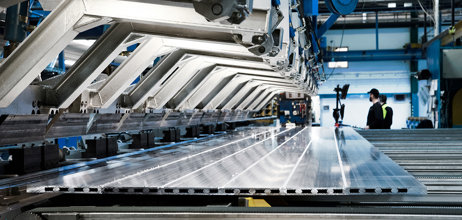
 TESTING: Hydro Aluminium R&D Bonn testing customized blanks at one of its test facilities. |
| |
Prof. Michel Rappaz (EPFL Lausanne) described the status and challenges in modelling of sheet ingot. While macroscopic models of solidification for DC casting are fairly mature, he noted that macrosegregation calculations are still a challenge for two reasons. “It is difficult to maintain the mass balance and we have to calculate with a lot of various origins for macrosegregation: shrinkage, convection, sedimentation, deformation,” said Rappaz.
For predicting defects, Rappaz stated that the R&D world had really moved forward over the past 4-5 years. Tasks to solve: In porosity, the curvature contribution needs to be described better; and in hot tearing, “the challenge is to combine coalescence, mechanical deformation and liquid feeding.”
Aluminium Research has even more challenges, explained Prof. Günter Gottstein, RWTH Aachen. He drew the attention to a revolutionary development in process simulation with integrated physically based material models that are now being applied to industrial materials and large-scale processes and – being based on physical principles down to the atomic scale – can be extrapolated beyond the limits of available process and data limits.
How to produce auto body components less expensively? Prof. Klaus Siegert, who is an expert for Metal Forming from the University of Stuttgart, suggested the process of hydro-mechanical deep drawing. Dies are produced fast and at a low price. The technology allows for stampings with tapered walls as well as for components with a complex part geometry. Plus, with less stages needed, the process generates less spring back.
But Siegert also turned to the other side of the medal: Presses were rather expensive due to their need for high ram force, also a hydraulic unit would be required – and the mere cycle for the “Hydromec” process has to run much longer than in conventional deep-drawing. In aluminium, the superplastically formable AA 5083 would be the alloy to choose. E.g. a license plate pocket was hydromechaincally deep-drawn with 1.6 mm thick sheet of this alloy in 20 minutes at 525°C.
What you gain at the end of the day, remains the most important question. For the production side, Stefan Kästner, who is plant manager at Hydro Aluminium Rolled Products Hamburg, gave an impressive example: an increase of the productivity per employee by 3.8 percent each year during 1998 to 2004. This was the time when former Reynolds rolling mills were being aligned to standards of the now Hydro roller group.
Kästner explained his own revamped plant: Not only some more modern machines had been installed and the product mix specialized. The whole logistic concept was reshaped, e.g. by:
- de-bottlenecking with a new pusher type furnace who accepts longer ingots and shortens heat cycles,
- the worldwide first usage of an automatic vehicle system for the coil transport between the processes and
- the also new high storage rack which even accelerates the cooling time.
All measures helped to mobilize creep capacity and increase the output by more than 50 percent. To achieve anything similar in the future, Kästner was 100 percent sure: “We will need more, not less, R&D.”
One, if not the foremost segment of growth is the automotive industry. Franz Steimmel from Hydro Aluminium Strip, stated that significant increases in aluminium usage are to be seen – and even more expected due to the ACEA agreements on lower fuel consumption. “In this process, it is even better if you can help the manufacturers save time and money in their processes” – for instance with a new coating unit as used in Hydro's Grevenbroich rolling mill, made possible by own R&D on new alloys, surface and lubrication systems.
 STRONG: A laser-alloyed engine block produced by Hydro Aluminium. |
| |
In the opening session of the Bonn symposium, RDB´s own scientists told some success stories and showed the structure of their work. Jürgen Hirsch explained how precisely rolling simulation enables to design a tailor-made product – by optimally adjusting the parameters alloy, temperature, number and time of rolling passes. Hirsch: “The resulting microstructure is modified by strain hardening, recovery, recrystallization, dissolution and precipitation.”
Joachim Höfler gave insight e.g. to the development of the alloy HA 1052 which was the only one to combine all main demands for lithographic sheet: mechanical and fatigue strength, graining and thermal stability. Höfler also mentioned the important development of brazing processes, which enabled aluminium to substitute copper in heat exchanger applications; a new market was created.
But where does it all start? With liquid metal. To keep it clean, many steps from degassing and filtration have been developed, said Gerd Ulrich Grün. An adequate rolling ingot geometry was achieved by steadily improving the mould design, for example the hot top type launched in 1984, and as a most recent result, the IPC mould, as developed at R&D Sunndalsøra. Today, numerical simulation tools help to reduce experimental costs significantly – and may help to find and pave even new aluminium ways.
|