Karmøy 40 years: Farmers and fishermen built large-scale industry


OFFICIAL OPENING: It was Hydros former CEO Rolf Østbye who carried out the official opening of the metal plant at Karmøy. After much agonizing he had reached the conclusion that it was aluminium Hydro should use the Røldal-Suldal power for. (Archive photo: Hydro)


(July 30, 2007) It couldnt exactly have been foreseen that light metal would take over from herring as the silvery principal industry for the residents of Karmøy municipality in south-west Norway - but that is precisely what happened, 40 years ago. On Friday it was 40 years since the first electrolysis cells were switched on in the aluminium plant at Karmøy.

In the late 1950s, it was reported in Oslo’s newspapers that Hydro was to set up a company in the county of Rogaland in south-west Norway. This caused local politicians in the region of Haugalandet to start setting their sights on getting Hydro to use the Røldal-Suldal power – that the company had managed to secure for its operations – in North Rogaland.

As far as the other kind of power was concerned – manpower – there was plenty of that. Over 1,000 people were reported to be available for work in Karmøy alone, should anyone decide to establish large-scale industry there.

Following meetings with representatives from Hydro, agreement was reached to use Håvik in Karmøy municipality as the location for the new company, but what Hydro was to establish in Karmøy was not yet clear.

The only thing that was certain was that the company – through its rights in Røldal-Suldal – had access to large quantities of power.

“It had to be aluminium”
In the view of Hydro’s CEO at the time, Rolf Østbye, it had to be aluminium. For the fishermen and farmers in Karmøy, aluminium was a new product – and it meant a new reality.

There were no more winter fishing trips for herring in February – shift work required a new daily rhythm. From the moment the first metal was tapped in 1967, the aluminium plant has been the cornerstone industry in Karmøy. The traditional primary industries were no longer the be-all and end-all.

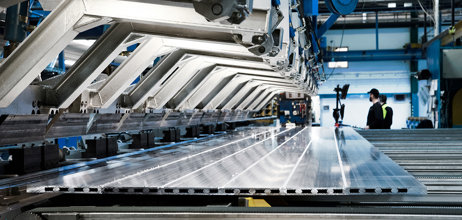
TODAY: Hydros plant at Karmøy is currently Europes larges integrated aluminium plant.


In the middle of the 1960s, aluminium was also a new product for Hydro. The company needed a partner. The French company Pechiney, the Canadian firm Alcan and America’s Alcoa were all considered, but in the end Harvey Aluminium in California was chosen – a company that had focused particularly on processing.

Within Hydro, it was seen as an advantage to cooperate with a company that was not too big, but that was independent.

The agreement resulted in the company Alnor Aluminium Norway Ltd, where Hydro held 51 percent of the shares and Harvey 49 percent. Scarcely a decade later, Harvey’s shares were bought up and Alnor became a Norwegian-owned company.

First metal, then processing
One of the topics discussed during planning of the company was whether or not an extrusion plant should be built first – for making aluminium profiles from purchased metal – before extending operations to include an electrolysis plant, casthouse and rolling mill.

Harvey had positive experiences from its extrusion plants in the US. Despite this, the extrusion plant ended up coming last, in January 1969. Its start in life was no easier than that of the electrolysis plant and the rolling mill.

Lorentz Conradi was the first manager of the company. Instead of recruiting people from the aluminium industry, Conradi wanted to bring in people with other backgrounds, including sailors and fishermen.

Conradi didn’t want any sharp divisions between workers and officials, or a rigid allotment of duties as found at Herøya and Rjukan. This attitude resulted in many interesting turns of event – for instance, many Karmøy residents who had emigrated to America now returned home, got a job at the plant, and were then sent for training in the US. American foremen and supervisors appeared on the scene at Karmøy.

NECESSARY POWER: When the pylons over the Karmsundet straits were felled by the storm in 1981, the metal plant at Karmøy faced its darkest hour in all respects. (Photo: Atle Johnsen)


Construction work and training took place simultaneously. At its height, the construction work – that began in the summer of 1964 – employed 1500 workers.

Around 200 acres of land were flattened to make room for the 770-metre-long electrolysis halls, which were further lengthened to 1000 metres in 1972. It was Norway’s largest industrial project since the construction of the iron mill in the northern town of Mo i Rana.

In July 1967, production of metal began in the first cells in electrolysis hall A. Three months later, hall B was completed. At this stage the plant had a smelting capacity of 88,000 tonnes.

The first shipment of aluminium was sent to China, but Europe was to become the metal’s primary market. Special sales offices were established to sell profiles, rolled material and wire products, and these were completely controlled from Karmøy.

What was special about Karmøy was not its metal production, but the fact that so much was invested in processing. The casthouse was the first of its kind in Europe, and it was to supply alloyed extrusion ingots to the extrusion plant.

The rolling mill was a “lightweight” in European terms, but it used liquid metal from the electrolysis plant, which was located next door. The rolling mill also built on Harvey technology, and used Harvey’s method of strip casting.

For the first few years things went well, but gradually changing economic conditions created problems for the company. Tariff barriers also contributed to limiting access to markets. There were times when management preferred to produce extrusion ingots rather than primary strip aluminium and sheet metal.

The “breaking-in” years for the metal plant were not too good, either. From 1973, Hydro had links with the Japanese company Sumitomo, which had achieved good results by improving Søderberg technology.

Even so, it would be a long time before the greatest technological difficulties were overcome.

Every cloud has a silver lining
Sveinung By arrived in Karmøy as a young metallurgist in the late 1960s. Among his clearest memories from that time are working with the Japanese, having training in Japan and the meticulous alterations of the operating routines at the electrolysis plant in Håvik.

An even stronger memory is the quite extraordinary challenge the plant faced when the pylons over Karmsundet – the straits between Karmøy and Haugesund – were brought down during a winter storm.

No-one – at the metal plant or in Røldal-Suldal Power – could imagine that Norway’s tallest pylons could fall down. But at 13:58 on Tuesday 24 November 1981, the unthinkable happened.

”The situation demanded a quite exceptional mobilization. Metal had to be emptied from the cells, and the anodes had to be driven down into the metal before it hardened. Even the office workers were given working clothes and sent out into production,” By recalls.

”A serious element of uncertainty during these dramatic days was whether or not we would be able to achieve a successful start-up once the electricity was back again. We lacked experience. Along with Hans Didrik Faaberg, who at that time was technical manager in Hydro Aluminium, I was sent to Pechiney in Paris, to compare notes. On the basis of these talks, we developed a procedure for starting up the cells again. Happily, the start-up exceeded all our expectations. A lot has been said about how the events back then contributed to creating a sense of solidarity, and gave the plant new impetus. To a great extent that’s correct. But many other factors also meant a lot for getting our operations to function in an orderly way over time, and thereby also achieving a good environmental standard,” By reflects.

COIL: An operator strap a continuous cast coil in the casthouse of Rolled products. (Photo: Michael Heffernan)


Since 1982, a profit has been made every year at the metal plant in Karmøy. Successful programmes have been carried out for improving operations, internal and external environment, and health and safety.

Expansions led to advancement
Having been a problem plant, Alnor – later Karmøy Metal Works – underwent three expansions, becoming so advanced it joined a new category of electrolysis plants.

The first expansion took place when Hydro approved the construction of K3 in September 1980. This meant increasing capacity by almost 50,000 tonnes, which increased annual production to 162,000 tonnes. Hydro wanted to contribute to developing industrial Norway, and was also in danger of facing a shortage of metal for its own processing business.

A new expansion took place in the spring of 1987 when K4 became operational, increasing production volume to 220,000 tonnes. This made the Karmøy factories Europe’s largest aluminium plant at that time. In 1992, capacity was increased by a further 55,000 tonnes annually.

Karmøy has its own testing hall, where for many years experiments have been carried out to increase the amperage in the electrolysis cells. Over time, this has contributed to an additional increase in the amount of metal produced.

Continual expansion has also resulted in additional jobs. Around the year 2000 the peak was reached, with 1760 employees. An Industrial Park has also been set up, to give room for other businesses. At the end of last year, Hydro had around 1400 employees in Karmøy.

Industrial power regime
The Karmøy plant’s emissions can be compared with the best modern production plants in the EU.

As a result of new European environmental regulations, however, the Norwegian Pollution Control Authority (SFT) imposed new emissions restrictions on the plant, which mean that the ageing Søderberg lines had to be phased out. Following an appeal from Hydro, Norway’s Ministry of the Environment has examined this decision and set new emissions limits for the Søderberg lines.

The new emissions limits are 3.2 kg per hour for polyaromatic hydrocarbons (PAH) and 35 kg per hour for dust. These rules ensure that the Søderberg plant can continue operations until the end of 2009, when it is due to be closed in order to meet even stricter demands regarding emissions that come into effect from 2010.

GROWTH: Sveinung By arrived at Karmøy a couple of years after production began. We have experienced over 30 years of growth, he stresses.


“People in Karmøy have been used to expansion for the last 30 years. If the Søderberg lines are now phased out, with their annual production of 120,000 tonnes, this will have serious consequences – also within our processing business. Locally, we all support a new building stage, K6. However, a prerequisite for this is that long-term power resources are also made available. There must be a political clarification with regard to this. We are waiting for an industrial power regime from the government,” Sveinung By comments.

Over the years, By has held many different jobs at Karmøy. Currently he is head of the Industrial Park, the main tasks of which are to supply shared services to the units at Karmøy, assist the units with restructuring, and contribute to getting new businesses set up. The Industrial Park is a significant user of natural gas.

”In various ways, I resemble many other people in industry, who have spent most of their working life in Hydro. The employer has provided new job opportunities within the same company along the way. In my case, I have been based at Karmøy all the time, but the jobs I have had range from electrolysis and casthouse work to marketing and personnel work. This has also given me plenty of room for professional development.”

Left Trondheim to strike root in Rogaland
”When I started off in my first job, I envisaged staying a few years in Karmøy. Although I grew up in Trondheim, I now feel like someone from the county of Rogaland – I have struck root in Haugalandet. Life here has been very good. My first meeting with the West of Norway left me with the impression that the landscape and climate were somewhat inhospitable. It’s actually more correct to talk of a mild climate, but winter is never far away if we decide to go up into the mountains. I have also greatly enjoyed being able to participate in local community life, both through union work, Karmøy’s industrial council, and the Haugesund region’s industrial association. Even though from time to time – even today – you can see traces of a tug of war between the many local communities that once upon a time made up seven municipalities, my impression is that Karmøy has become a very open community, where it is also easy for people moving in from outside to feel at home,” Sveinung By reflects.