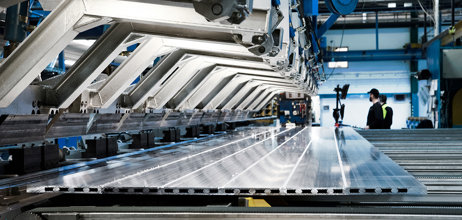
Without Hydro, Fido would be out of a job

(August 31, 2007)
We often take little things like our morning newspaper for granted. But we'd miss them if they weren't there. And Fido would be out of a job. Did you know that Hydro makes your morning newspaper possible?

FidoThere’s a good chance your morning newspaper or favorite magazine was printed using aluminium lithographic plates from Agfa – using aluminium from Hydro.

Much has changed since Johannes Gutenberg invented “modern” printing with moveable type more than five centuries ago. Today, computers using lasers can etch words and images directly onto aluminium lithographic plates – and up to four printing plates, one for each colour ink, are needed for every single page.
Agfa uses lithographic sheet stock from Hydro, the world's leading producer of aluminium strip and sheet for the offset printing industry.

Aluminium is ideal

Agfa uses lithographic sheet stock from Hydro, the world's leading producer of aluminium strip and sheet for the offset printing industry.

Aluminium is ideal for offset printing plates due to its physical and chemical characteristics, such as low weight, high tensile strength, corrosion resistance and easy recyclability – and Agfa is one of the global leaders.

Aluminium for printing plates must have excellent, defect-free surface quality, higher than average flatness, electrochemical grainability, and specific mechanical properties.

“It’s very high quality aluminium, 99.5 percent pure,” says Agfa’s marketing manager, Tony King, based at Agfa’s graphics facility at Leeds in the UK.

Hydro is world’s leading producer of aluminium strip and sheet for the offset printing industry, and has a world-wide contract to supply Agfa. Coils of plate stock come in widths of 800-1,500mm and gauges .12 mm to .48 mm, in two different alloys.

The offset printing process, which can mean up to a million impressions and printing speeds of 50,000 revolutions per hour, demands high-grade printing plates.

Anodized aluminium

Litho process

The offset printing process, which can mean up to a million impressions and printing speeds of 50,000 revolutions per hour, demands high-grade printing plates.

Agfa take the coils of plate stock and grains and anodizes them before applying the final light-sensitive coating that makes offset printing possible. Graining is an electro-chemical treatment that roughens the surface.

“A large part of Agfa’s graphics business is grained and anodized printing plates,” explains Tony King. “We supply different types of lithographic plates to printers of all types: newspapers, magazine, commercial printers.”

“It produces a highly water-receptive state, like a sponge,” King explains. “Water doesn’t mix with oil-based ink, so when the plate is printed, ink won’t stick where there is no image.”

Graining, as shown in this micrograph of three individual dots on a developed printing plate, makes the surface water-absorbent.

Litho surface

The offset printing process, which can mean up to a million impressions and printing speeds of 50,000 revolutions per hour, demands high-grade printing plates.

Agfa demands two things from its suppliers: high-quality, consistent material and dependable, on-time delivery.

“The specifications and tolerances are very tight. You need very specific composition and quality. It has to have suitable tensile strength; if not, the plate can crack and go flying off the press,” says Tony King.

He points out that the plates are recycled for other uses. “They’re too valuable to throw away, so this is an environmentally-friendly industry.”