


How Bayards and Hydro gave aluminium a second life
A helicopter platform is indispensable for emergency care, yet it is rarely seen as the starting point of a circular success story. Still, that is exactly what Bayards and Hydro achieved together. Aluminium from a decommissioned helicopter platform in Dresden was given a new life on the roof of a hospital in Tilburg, the Netherlands — without compromising on safety or quality.
At a time when hospitals face increasing pressure to reduce their CO₂ emissions and comply with European sustainability regulations, this project demonstrates how circularity works in practice. Not as an abstract ambition, but as a concrete solution within critical healthcare infrastructure.
The project began in Germany, where Bayards UP dismantled an aging rooftop helicopter platform in Dresden. Instead of sending the aluminium off as scrap, Bayards and Hydro deliberately opted for a closed, controlled recycling loop.
- Selective decommissioning (Dresden)
The structure was carefully dismantled, with maximum attention to preserving material quality.
- Remelting and processing (Hydro Ghlin)
The aluminium was melted down and processed into billets, with minimal material loss.
- New profiles (Hydro Lichtervelde)
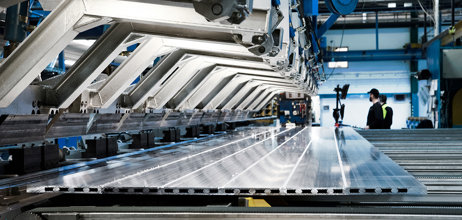
High-quality profiles were made from the billets using Hydro CIRCAL 75R – aluminium consisting of at least 75% post-consumer scrap.
- Application in healthcare (Tilburg)
The profiles will be used later this year in a new helicopter platform at a Dutch hospital, where emergency medical flights land daily.
This is one of the first projects in Europe in which a fully circular loop has been achieved within a safety‑critical aviation application. The new helicopter platform in Tilburg symbolizes how healthcare institutions can accelerate their sustainability goals. Circularity and safety are not opposites — they reinforce each other.
Circularity becomes a reality when partners are willing to re-examine the entire value chain. By closing the loop together with Bayards, we demonstrate how aluminium can return to society as high-quality care infrastructure. — John Baars, Account Manager, Hydro Extrusion Netherlands
For Bayards, the project also highlights what becomes possible when sustainability is considered from the very beginning.
This project demonstrates that circular healthcare infrastructure is not only feasible but also future-proof. The reuse of aluminium from one helicopter platform for another proves that safety, regulations, and sustainability can go hand in hand. — Martin de Groot, Director of Bayards UP
Why circularity matters to hospitals
Hospitals across Europe are facing stricter requirements regarding sustainability and reporting. This project aligns directly with key policy objectives, including:
- compliance with EU guidelines for ESRS and Scope 3 reporting;
- support for green public procurement (GPP);
- more efficient use of materials in the construction and renovation of healthcare facilities;
- Visible sustainable leadership towards patients and employees.
By choosing aluminium with at least 75% post-consumer scrap, the helicopter platform achieves:
- up to 70% CO₂ reduction compared to primary aluminium;
- less use of new raw materials;
- less waste during demolition and renovation;
- lower transport-related emissions.
Closing the loop with Hydro shows what is possible with partners who share the same long-term vision. This is just the beginning. — Marco Tanis, Director of Bayards Helidecks
A blueprint for the future
The circular journey from Dresden to Tilburg is more than a one‑off achievement. It is a replicable model for future projects, both within and beyond healthcare. Bayards and Hydro plan to apply this approach to more helicopter platforms, roof structures and other aluminium applications.
This project shows that sustainability does not need to be a separate track — it can be an integral part of mission‑critical infrastructure, today and in the future.
