


Working with designers to shape the market for greener aluminium
When Hydro launched Hydro CIRCAL 100R in 2024, the world’s first aluminium made with 100 percent post-consumer scrap, we wanted to demonstrate that recycled aluminium can meet real design and manufacturing expectations, while keeping the same standards for quality, aesthetics, and technical performance. Here’s how it went.
Recycling and keeping products and materials from ending up in landfill is a key part of Hydro’s overall strategy. We know that each year, more than 10 million tonnes of furniture get thrown out in Europe, and only about 10 percent is recycled and put back in the loop. In addition, studies show that over a typical commercial building’s 60 year lifespan, furniture and interior refurbishments can accumulate a carbon footprint that is equal or even greater than the original embodied carbon of the building’s structure and envelope.
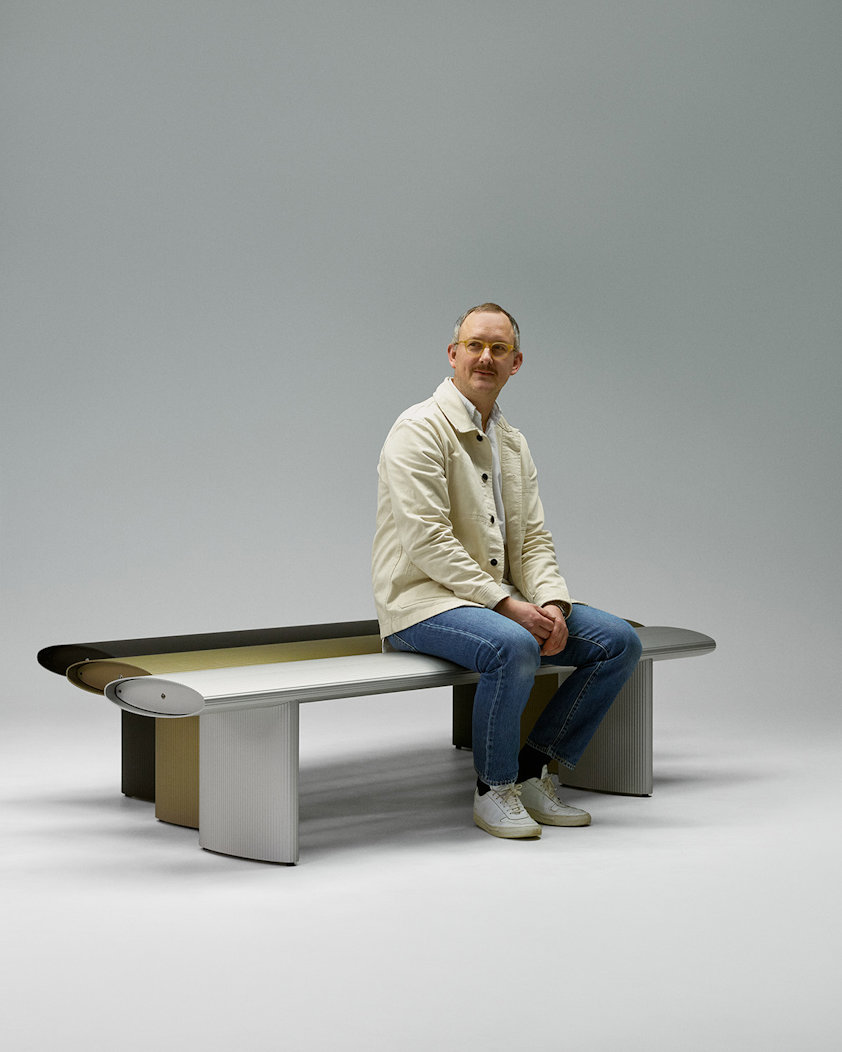
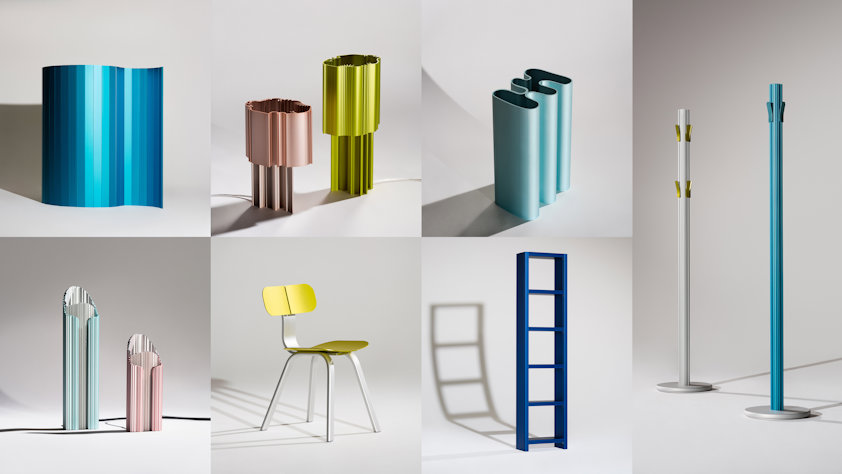
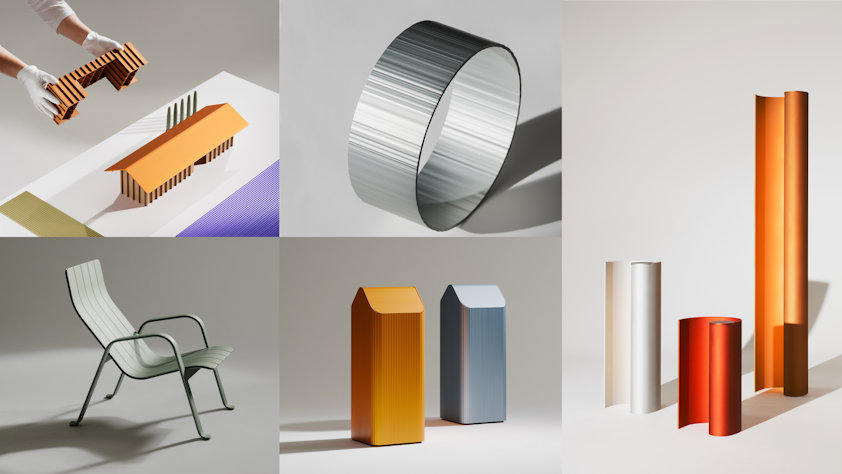
To address this issue, Hydro has for the past two years worked closely with 12 designers to create 12 unique products made entirely from 100 percent recycled aluminium. Through the 100R and R100 projects, Hydro showcased the material and finished pieces at design fairs all around world, including Milan Design Week, 3daysofdesign (Copenhagen), Material Matters (London), and Dutch Design Week (Eindhoven).
The idea of creating mono-material exhibitions began in 2022 when Hydro worked with Lars Beller to create Bello!, a single alloy piece made from nearly 90 percent recycled aluminium. Following the launch of Bello! at Milan Design Week 2023, Hydro instituted a program of collaboration with designers such as Lars to drive innovation in the design industry and encourage the creation of more sustainable products in recyclable aluminium.
Turning post-consumer scrap into design objects
No one is better suited to demonstrate the possibilities of aluminium extrusion than today’s top designers, and through close collaboration with Lars Beller Fjetland, who served as Art Director for both projects, and the engineering team in Hydro, we put one clear idea in front of the design world: mono-material objects made from 100 percent recycled aluminium. Everything, from the finished product designs to the elements in the exhibition layout, was to be made from the same pile of post-consumer scrap. We even put the name of the material itself, Hydro CIRCAL 100R, front and center in the 100R project when we first premiered it at Milan Design Week 2024.
“When designers, engineers and material experts unite, real innovation happens. That’s why it’s essential for us to work with designers from the very beginning of the process, because innovation and sustainability start at the drawing board,” says Asle Forsbak, Marketing & Communication Director in Hydro Extrusions.
Why we raised the bar with R100
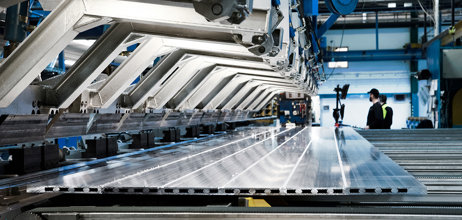
Following the success of 100R in 2024, we turned our focus to the transportation aspect and set a goal to demonstrate urban mining put into practice. R100 kept the 100 percent post-consumer baseline and added a new constraint: a 100 km production radius. We harvested 52 tonnes of scrap from decommissioned greenhouses and light poles in the Netherlands, then cast, extruded, machined ,and finished within a 100 km radius in the Benelux region. This resulted in a roughly 90 percent cut in transportation related emissions compared with the previous year’s setup.
We talk about “farm to table” food. With R100, we wanted to start a similar conversation about aluminium manufacturing. Small manufacturing clusters is not necessarily unique to the R100 project, but it is typical for how Hydro works with its customers, allowing us to have full traceability of the material, from aluminium scrap to final product.
For instance, we did a carbon calculation for John Tree’s Billet Chair, and factoring in operations like transport, extrusion, surface treatment and fabrication, the total emissions came to 2.1 kg CO₂e for 5 kg of aluminium, or 0.416 kg CO₂e per kg.
Scaling recycling to hit our 2030 ambition
Hydro has an ambition of reducing our own emissions by 30 percent by 2030, and the fastest way to achieve this is by scaling our recycling capabilities to recycle more post-consumer scrap.
Hydro CIRCAL 100R has a carbon footprint of less than 0.5 kilo CO₂e per kilo aluminium. This is roughly 33 times lower than the global average. Production procedures, documentation, and processes are verified annually by DNV, and in early 2024 we received an Environmental Product Declaration covering Scopes 1, 2 and 3 for this near-zero product.
Hydro is continuously exploring new possibilities, both to sourcing more post-consumer scrap and develop advanced sorting technologies. Hydro’s proprietary HySort technology, which utilizes laser induced breakdown spectroscopy (LIBS), allows Hydro to dig deeper into the scrap pile to recycle aluminium that would otherwise end up in landfills.
When it comes to scaling hyper-local supply chains, we know there are a few hurdles. It will depend on better scrap segregation, stronger relationships with suppliers and demolition contractors, and the ability to reserve volumes as projects are decommissioned. Hydro sees this as a long-term ambition as more and more scrap becomes available, and value chains become more streamlined.
Recognition from the design community
Our work has earned recognition across design and innovation, most notably receiving the ELLE Decoration’s Sustainable Achievement of the Year for the launch of Hydro CIRCAL 100R at Milan Design Week in 2024, and the Sustainable Project and Material Innovation award at the Dezeen Awards 2025. See the full list here.
Full list of the 100R & R100 designers and products
- Inga Sempé: Grotte Lamp [100R]
- Max Lamb: Prøve Light [100R]
- Shane Schneck: Nave [100R]
- Rachel Griffin: Serial [100R]
- Andreas Engesvik: Tsuba [100R]
- John Tree: Billet Chair [100R]
- Philippe Malouin: T-Board [100R]
- Sabine Marcelis: Orbit [R100]
- Keiji Takeuchi: Profil [R100]
- Cecilie Manz: Rør [R100]
- Stefan Diez: Boss [R100]
- Daniel Rybakken: Fields [R100]