
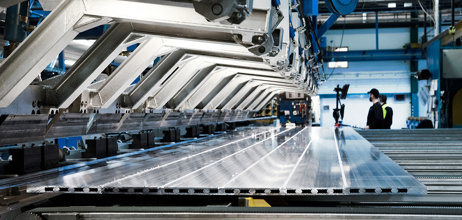


This indirect extrusion press investment marks the latest step in Hydro’s strategic modernization efforts in North America. The investment will replace equipment from the 1950’s, bringing with it Industry 4.0 technology, advanced automation, increased energy efficiency and best in class safety performance.
“We are extremely proud of this new equipment and the additional capabilities it brings to Hydro Cressona. This project will improve efficiency, enhance product quality and expand our indirect extrusion capacity to serve the growing needs of our key customers,” says Mike Hammer, Vice President & General Manager of Hydro Extrusion North America’s Industrial and Distribution Region.
Demand for indirect extrusions continues to grow in the commercial transportation, automotive, and electrical markets, where customers increasingly require high performance profiles with consistent dimensions, superior grain structure, and consistent mechanical properties. With this expanded indirect extrusion capacity, Hydro is well positioned to capitalize on these trends.
Investing in American competitiveness
Hydro has a robust presence in the United States, with nearly 6,000 employees and 19 production sites across 14 states. With plans to invest more than USD 800 million over the next five years, the company has raised concerns about the impact of U.S. tariff policy on the competitiveness of domestic manufacturing. Extrusion presses and other specialized equipment produced only in Europe are currently subject to elevated and frequently changing tariffs that increase costs and drive uncertainty.
"This investment is about much more than a new piece of equipment. It is about Cressona, our employees, our customers and the future of manufacturing in North America. Cressona continues to serve as the keystone of our North American operations, and we’ve invested more than USD 150 million in the site over the past three years. We remain fiercely committed to investing in our U.S. operations, but the aluminium industry needs more nuanced trade policies that do not increase the cost of capital equipment and hinder industrial growth,” says Jeff Lehman, Business Unit President, Extrusion North America.

About Hydro Cressona
Hydro’s facility in Cressona, Pennsylvania, was originally built in 1942 by the U.S. government and is the largest aluminium extrusion site in the western hemisphere, with~15.8 hectares (148,000 square meters) under roof. The site has more than 1,200 employees, nine extrusion presses, three extrusion ingot casting units, extensive fabrication capabilities and a distribution warehouse.
What is an indirect extrusion press?
Aluminium extrusion shapes heated aluminium by forcing it through a die to create a specific profile. In conventional direct extrusion, the aluminium billet moves toward a stationary die. In indirect extrusion, the die instead moves into the billet, reducing friction between the billet and the container.
The process can provide more consistent dimensions, grain structure, and mechanical properties, making it well suited to demanding applications where consistency and product performance are important. At Hydro Cressona, demand for indirect extrusions is growing in markets including commercial transportation, automotive and electrical. Indirect extrusion is a specialized process, while direct extrusion remains the more commonly used method for producing aluminium profiles.
Published: October 28, 2026
