


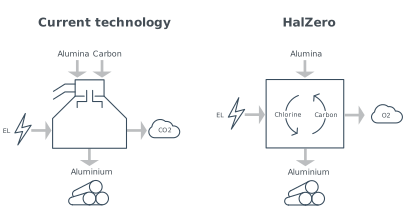
Since 2016, Hydro’s technology teams have been working to develop HalZero, an entirely new process for producing primary aluminium, which could replace the technology used globally today, first patented in 1886. The new technology is based on converting alumina into aluminium chloride before electrolysis in a process designed to keep chlorine and carbon in closed loops. The long-term ambition is to eliminate CO2 emissions from both electrolysis and anode production, releasing oxygen instead of CO2.
Hydro has now produced metal from aluminium chloride for the first time at its research and test facility at Herøya in Porsgrunn, Norway. The test facility was built with support from Enova, a state enterprise owned by the Norwegian Ministry of Climate and Environment, which awarded NOK 141 million in 2023 for the construction and operation of the facility. The test center has been in operation since January 2026, and is being used to test the individual process steps in the HalZero technology.
“This is an important milestone for Hydro and Norway’s technology and research communities, and a significant step forward in the development of HalZero. Producing the first metal demonstrates the technology developed in partnership with leading Norwegian research institutions, including NTNU and SINTEF, works. It paves the way for the continued development, maturation and testing of a technology with the potential to enable emission-free aluminium production in the future,” says Eivind Kallevik, President and CEO of Hydro.
HalZero is a long-term technology development program and one of Hydro’s most demanding technology initiatives in decades. Producing the first metal represents a major step forward, although several years of targeted testing and piloting remain before the technology could be ready for industrial use.
The main HalZero processes are being tested at the Porsgrunn facility. At this stage, production still generates CO2 emissions. The next step will focus on developing an industrial concept pilot, with the ambition of integrating and testing all the necessary process steps together.
The purpose of the pilot will be to establish the basis for the further industrial scaling of HalZero, with the aim of achieving net-zero emissions from primary aluminium production.
“Aluminium is a critical material for the energy transition and for transport, buildings, and infrastructure. If the world is to succeed in reducing emissions, we must also transform the way aluminium is produced. Developing an entirely new technology is demanding and takes time, but Hydro has both the expertise and a responsibility to help move the aluminium industry forward. That is what we are working to achieve with HalZero,” says Kallevik.
Hydro has invested significant resources in developing HalZero over several years. Funds from the climate and energy component of Norway’s CO2 compensation scheme are also used to support this work. Further progress depends on using the test facility over the coming years for systematic learning, testing and continued technology development. The experience gained at the test center will provide the basis for further work on the industrial concept pilot and subsequent assessments of industrial scale deployment.
Enova has now granted an additional NOK 82 million for the development of the project’s next phase, an industrial concept pilot for HalZero.
About HalZero
Primary aluminium is currently produced mainly using the Hall-Héroult process. Developed in 1886, this electrolysis technology remains the dominant industrial method for producing primary aluminium. In the process, oxygen from alumina reacts with carbon anodes, generating CO2 emissions.
HalZero is Hydro’s proprietary technology for primary aluminium production. It is based on converting alumina into aluminium chloride before electrolysis. In the HalZero process, chlorine and carbon are kept in closed loops, enabling the process to eliminate CO2 emissions from electrolysis and anode production.
HalZero is part of Hydro’s technology roadmap towards net-zero emissions from aluminium production.
Published: October 19, 2026
