


How technology can strengthen HSE performance: Hydro’s approach to safer and smarter operations
For Hydro, technology has become an increasingly important enabler: not as a substitute for leadership, risk awareness or employee engagement, but as a way to give people better information, earlier warnings and more effective tools for preventing incidents.
As the aluminium industry gathers at ALUMINIUM 2026 in Düsseldorf, Germany in October 2026, health, safety, and environment (HSE) remains central to how companies build resilient, responsible, and competitive operations.
“For us, using technology and digital tools in HSE is not about replacing people, leadership or judgement. It is about giving leaders and employees better insight, earlier warning signs, and more effective tools to act before incidents happen,” says Jurgen Mathijs, Head of Group HSE in Hydro.
Across industrial operations, HSE has evolved from a primarily compliance driven function into a business critical capability. Regulatory requirements, stakeholder expectations, and operational complexity continue to increase, while companies are also expected to improve productivity, reduce environmental impact, and maintain safe workplaces.
“Digital connectivity, cloud based systems, artificial intelligence, real time analytics and immersive training are creating new possibilities for how risks are identified, understood, and managed. In Hydro, we are using digital reporting systems, advanced analytics, virtual reality, and emerging AI capabilities to strengthen learning, improve risk management, and support more consistent ways of working across a global organization,” says Mathijs.
From reporting to insight: Hydro’s Incident Management System
For many years, HSE processes in industry depended heavily on paper forms, spreadsheets, filing systems and manual follow up. Inspections, incident investigations, corrective actions, and information and trend analysis were often analyzed weeks or months after an event occurred. That made it more difficult to identify patterns early and to act before risks developed into serious events.
The introduction of various technologies such as cloud computing, mobile devices and custom software solutions pioneered Hydro’s digital transformation journey over a decade ago. Hydro’s Incident Management System (IMS) has expanded the organization’s digital HSE capabilities.
“IMS has helped us move from fragmented reporting toward a common digital platform for registering, analyzing and following up HSE events. It captures incidents, near misses, environmental events, audits, reviews, and other HSE related information, creating a more complete basis for learning across locations and business areas,” says Jason Floyd, Director of Health, Safety & Security in Hydro Extrusion North America.
The latest generation of IMS (IMS2) enables Hydro to monitor and share incident details, risk assessments, and HSE statistics with far greater speed and granularity than traditional methods allowed. Hydro can now monitor and share incident details, HSE statistics in detail down to the employee’s time with the company and position, location working at the time of the incident and list the various types of contributing factors via a tag system as well as risk assessments in real time. The system generates vast amounts of actionable data that supports faster decision making, and improved risk and HSE management.
“Without reliable digital reporting, we would be operating with limited visibility. IMS gives our teams a common source of information. It helps us move faster from knowing something happened to understanding why it happened, where similar risks may exist and what we need to do to prevent a recurrence,” Floyd says.
Artificial intelligence and predictive risk management
“Artificial intelligence is one of the most significant developments influencing the next phase of HSE management. In Hydro, AI is being explored and developed as a way to analyze large volumes of HSE information, improve access to procedures and guidance, and identify patterns that can support earlier intervention,” says Mathijs.
A key opportunity is predictive analytics. Traditional safety performance has often been assessed through lagging indicators, such as injuries after they occur.
“Our internal custom built AI HSE Assistant is connected to our IMS database and can analyze large volumes of data from policies and procedures, inspections, incidents, audits, observations, training records, maintenance reports, and sensor networks to identify patterns and predict future risks,” explains Floyd.
Hydro collects substantial amounts of information through Walk Observe Communicate (WOC) activities, injury free event reporting, audits and incident investigations. Analyzing these datasets manually can be challenging, particularly when the most important signals are not obvious in individual cases. AI can help highlight recurring themes, compare data across locations and support HSE professionals in identifying areas that require closer attention.
“The aim is not to remove human judgement from HSE decision making, but to strengthen it. Better analysis can free up time for HSE professionals and operational leaders to spend where they have the greatest impact, in the field, engaging with employees, understanding how work is actually performed, and removing barriers to safe operations,” says Mathijs.
“AI allows us to connect information in ways that were not possible before. But the real value is created when insights are translated into action. Our focus is to use digital tools to support visible leadership, stronger risk understanding and better learning across Hydro,” says Floyd.
Virtual reality for safer training
Virtual reality (VR) is another area where technology is changing how employees are trained for complex and potentially hazardous tasks. In an aluminium plant, some of the most important learning situations are difficult to recreate safely through traditional classroom instruction.
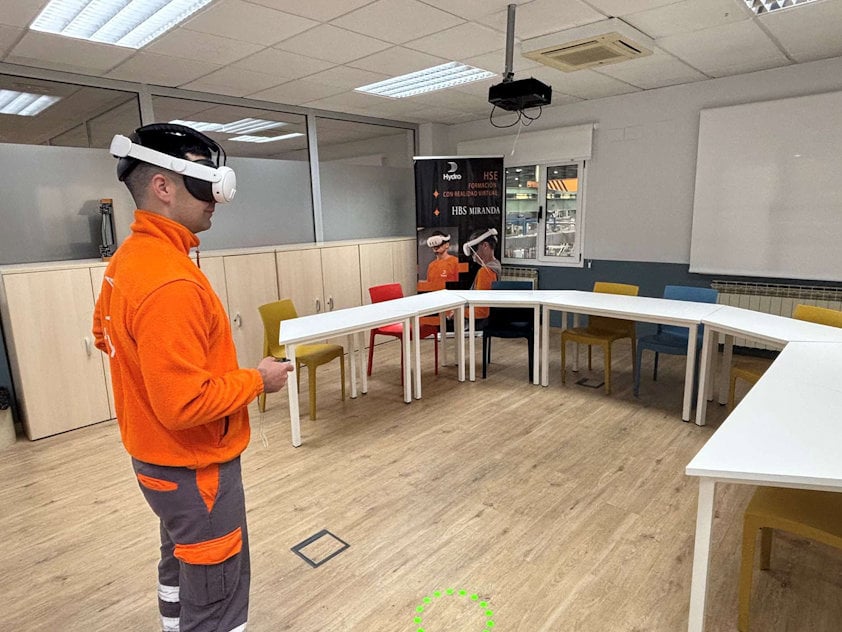
“VR makes it possible to practice hazard recognition, emergency response and task preparation in realistic environments without exposing employees or equipment to actual risk. Hydro has developed VR training simulations that allow employees to practice scenarios such as emergency response, forklift operations, lockout/tagout activities, confined space entry and hazard identification in virtual plant environments,” says Floyd.
This type of training can help employees build confidence, recognize risk factors earlier and understand the consequences of decisions before they face similar situations in real operations.
For global companies, digital training also supports consistency. While local hazards and regulatory requirements vary, common training concepts and shared learning materials make it easier to scale good practice and ensure critical safety principles are understood across locations.

Environmental compliance and sustainability
The digitalization of HSE also extends to environmental management. Aluminium producers are expected to meet increasingly demanding requirements from regulators, customers, investors and local communities. Reliable data is essential for demonstrating compliance, improving performance and identifying opportunities to reduce environmental impact.
Environmental monitoring systems and analytics platforms can track emissions, air quality, water quality, waste generation and resource consumption more efficiently than manual processes. Automated reporting and structured data collection improve accuracy and reduce administrative effort, while giving operational teams better visibility of trends and deviations.
For Hydro, environmental excellence is closely linked to safe and responsible operations. Digital tools support sustainability initiatives by helping identify opportunities to reduce energy use, greenhouse gas emissions, waste, and resource consumption, while also strengthening transparency, accountability, and corporate sustainability goals.
“HSE is not a separate layer on top of operations. It is part of how we run the business. Technology and digital systems help us create better visibility and more consistent follow up, but they must always be anchored in ownership, competence, and a culture where people speak up and learn from each other,” says Mathijs.
Technology with people at the center
Technology is fundamentally transforming the field of HSE management. Innovations such as artificial intelligence, connected worker systems, wearable devices, cloud based platforms, and immersive training technologies are enabling organizations to identify hazards sooner, improve compliance, and reduce workplace risks more effectively than ever before.
“Technology alone will not create safer workplaces. The strongest results come when digital tools are combined with visible leadership, operational discipline, employee involvement and a learning culture,” says Floyd.
The purpose of HSE technology for Hydro is to support people, helping leaders and employees see risks earlier, make better decisions, and share learning more effectively.
“The goal is not technology and digitalization for its own sake. The goal is to make sure the right information reaches the right people at the right time, so they can take action. When technology helps us prevent an injury, improve a process or learn from another site, that is where it creates real value,” says Mathijs.
This article was first published in the Aluminium International Today - Safety Guide 2026.