When you choose aluminium from Hydro, it's strong, light, durable and climate efficient, making you part of a smarter and more sustainable future. Our climate strategy is to cut our CO2 emissions 30% by 2030. Our aluminium can help you meet your goals, too.
Energy
Hydro has been at the forefront of the energy transition since 1905, transforming industries and societies with renewable energy. Today, we are pioneering the green aluminium transition through renewables and new energy solutions.
Sustainability
We want to contribute to the just and green transition through responsible production, creating circular solutions and delivering net-zero aluminium by 2050 or earlier.
Careers
At Hydro, we put our people at the center of everything we do. By supporting our employees’ growth professionally and personally, we are fostering a community of colleagues who are united in the shared purpose of solving our industries’ most pressing challenges.
Investors
With more than a century of industrial experience, we are enabling the green transition through innovation, technological advances, and a strong commercial mindset.
Media
Working on a story about aluminium? Press releases, photos, stories, facts and figures – you will find everything you need here.
About Hydro
Hydro is a leading aluminium and renewable energy company that builds businesses and partnerships for a more sustainable future. We have 32,000 employees in more than 140 locations and 40 countries.
Tube and fin remains the most common heat exchanger design in HVAC&R, and Hydro supplies aluminium tubes as a direct alternative to copper tubes. Pairing aluminium tubes with aluminium fins, you remove the galvanic mismatch that shortens coil life and eliminate formicary corrosion entirely, while cutting weight, material cost and recycling complexity at end of life.
Pairing copper tubes with aluminium fins puts two dissimilar metals in constant contact, and over time that galvanic mismatch leads to premature erosion of the fins. An all-aluminium design significantly reduced this problem as aluminium is immune to formicary corrosion, a failure mode in copper tubes estimated to cause around 10% of premature indoor heat exchanger failures.
And the benefits go beyond corrosion:
Lower material cost: Aluminium costs around a quarter of copper as a raw material, and application studies show bill-of-material savings of 34% to 48%.
Lighter units: Depending on the design, total heat exchanger weight drops by 17% to 34%, and tube weight by roughly two-thirds.
More refrigerant options: Aluminium is compatible with ammonia (R717) systems, which copper is not.
Simpler recycling: All-aluminium heat exchangers are easier to recycle, with no material separation required.
Aluminium alloys for tube and fin heat exchangers
Hydro supplies dedicated alloys for tube and fin heat exchanger construction: 3102E for straight grooved tubes, and 3003/3103 for straight and helical grooved tubes. For higher corrosion resistance, 9159 is recommended for straight inner-grooved and 9159 for helical inner-grooved geometries.
A zinc (ZAS) coating is recommended on round tubes for outdoor applications Each alloy combination is validated by accelerated corrosion testing before being finalised for production.
In accelerated corrosion testing (SWAAT), a zinc-coated Hydro 9159 tube lasted up to 208 days to perforation, compared with 152 days uncoated and 60 days for a zinc-coated 3003 reference tube.
Tube geometry for tube and fin heat exchangers
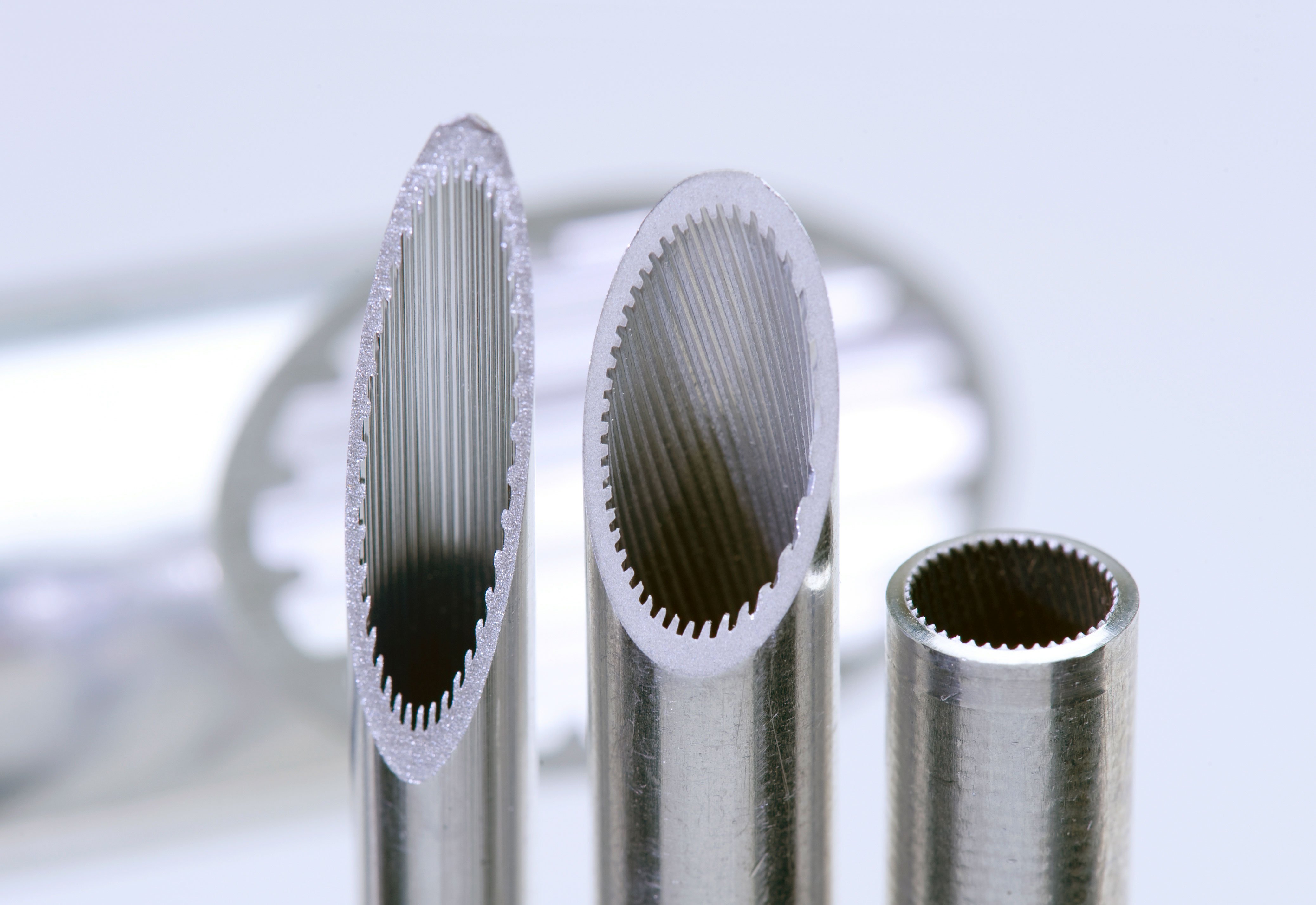
Much of a coil's performance is decided inside the tube. Our Hygroove internally enhanced tubes, available with straight or helical grooves, can raise the refrigerant-side heat transfer coefficient by 50% to more than 300% compared with a smooth tube, depending on refrigerant, flow rate and groove type. The right geometry balances that gain against pressure drop, and our engineers can help you find the best fit for your system.
Where our tubes are used:
Comfort cooling and heating coils for commercial and residential HVAC
Refrigeration coils for display cases and cold rooms
Coils for corrosive environments, such as coastal and industrial installations
Frequently asked questions
Yes. Aluminium is used in tube-and-fin heat exchangers, micro-channel heat exchangers and line set applications. Compared with copper, aluminium offers lower weight, improved recyclability, lower material costs and compatibility with ammonia refrigerant. Aluminium is also immune to formicary corrosion.
A tube and fin heat exchanger pairs round or oval tubes with stamped or corrugated fins, mechanically expanded together to form the coil. Hydro supplies the aluminium tube, fin, and alloy solutions used in this design as a direct alternative to copper tube/aluminium fin coils.
3102E and 3003/3103 for standard straight and helical grooved tubes, and 9159 for higher corrosion resistance. A zinc (ZAS) coating is recommended on round tubes for outdoor units.
Formicary corrosion is a failure mode that affects copper heat exchangers, estimated to account for around 10% of premature indoor heat exchanger failures. Aluminium is immune to formicary corrosion.
Savings depend on design and region; specific coil analyses have shown bill-of-material savings of 34% to 48% when substituting aluminium for copper.