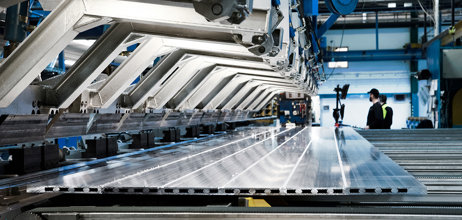
Forming aluminium extrusions for complex geometry
Aluminium's formability makes it possible to create complex parts without adding weight. We use forming methods including hot gas forming, hydroforming, stretch forming and bending, supported by simulation and testing, to achieve high dimensional accuracy.
Mechanical joints vs welding
Extruded aluminium profiles can be designed for efficient mechanical joining. Mechanical joints are often simple to assemble, some can even be completed by the end user, and allow surface finishing on long lengths before cutting, reducing cost.
CNC machining and punching
Aluminium profiles can be designed to need minimal machining after extrusion, but some processing is often required. Machining aluminium is relatively inexpensive: its malleability keeps tooling costs competitive, and higher cutting speeds than steel keep machining costs low. Punching complements machining for large series, covering hole-cutting, cutting out blanks and cutting off lengths quickly and cost-effectively.
Hydroforming and bending
Hydroforming is a process that uses internal fluid pressure to form an aluminium tube into a complex three-dimensional shape in a single operation. We bend profiles and tubes to a defined radius, using stretch bending, roller bending, press bending or draw bending. Draw bending is the most widely used method, offering tight radii and good repeatability.
Added-value machining: from profile to part
When you order extruded profiles from Hydro, you can add value with machining operations such as sawing, turning, drilling, milling and threading, as well as deburring and punching. Punching can include hole-cutting, cutting out blanks and cutting off lengths.

Beyond extrusion, we offer finishing, joining, assembly and logistics services so you receive parts ready for your production line or project.
|
Lacquering
 |
Lacquering adds durable colour and surface protection to aluminium profiles and parts, with resistance to UV, corrosion, impact and abrasion.
|
Anodizing
 |
Anodizing is an electrolytic surface treatment that hardens and protects the aluminium surface while giving a natural metallic feel. It resists corrosion and wear, with a range of colour tones available.
|
|
Crimping / Barrettage
 |
Crimping (barrettage) joins aluminium profiles with polyamide bars to create a thermal break, useful for building applications requiring improved thermal performance.
|
Cut to length
 |
We cut extruded aluminium profiles to length, from 5 mm pieces to lengths of up to 12 metres, to match your assembly or delivery needs.
|
|
Machining
 |
Our CNC machining capability, including 5-axis machining centres, handles parts from small automotive components to multi-metre building-industry profiles, and can multiply the functions integrated into a single profile.
|
Punching
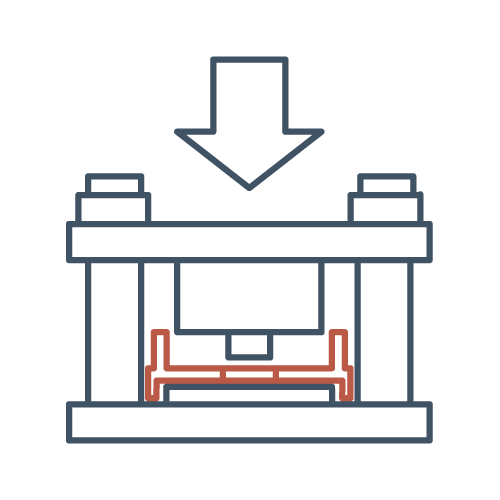 |
Punching is fast and cost-effective for large series production, using dedicated tooling for shearing and cutting.
|
|
TIG / MIG welding
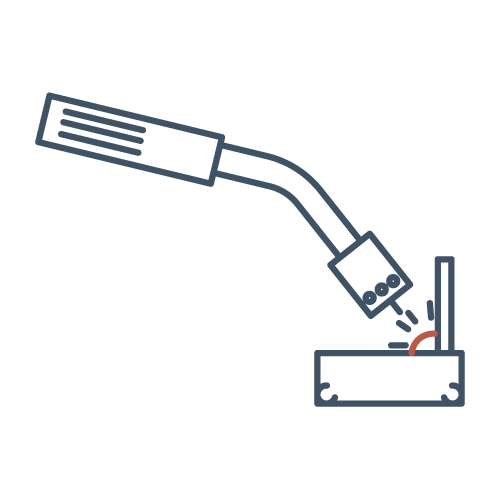 |
6000-series aluminium alloys weld well using TIG or MIG processes, and extrusion design can integrate features that make welding easier.
|
FSW welding
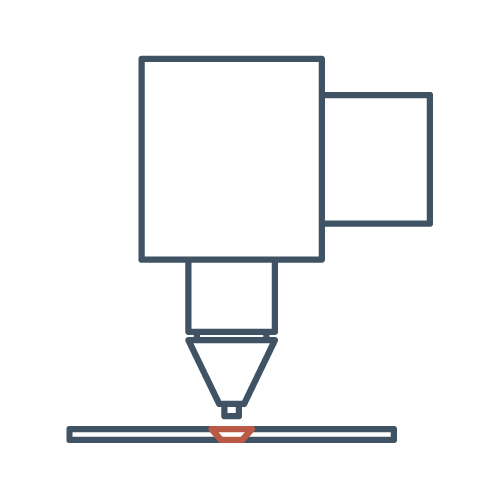 |
Friction stir welding (FSW) joins aluminium by mixing the material with a rotating tool rather than melting it, giving a homogeneous, flush weld with reduced distortion and strong thermal performance.
|
|
Bending
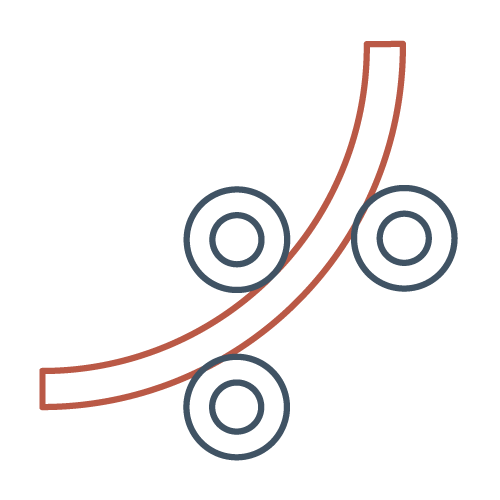 |
Bending method depends on bend radius, profile shape, appearance and production volume. We offer draw bending, stretch bending, roller bending, and press bending.
|
Mounting and assembly
 |
We can assemble your components before delivery, from gasket installation to crimped threaded inserts, so you receive a finished, ready-to-install product.
|
|
Kitting
 |
We can prepare your parts in kits tailored to your specifications, including protective film, labelling, and screw-bag inclusion.
|
Storage
 |
We can store your profiles under agreed conditions and release them according to your supply schedule.
|