


Meet Jason Rietveld: From the pitcher’s mound to the production line
At Hydro’s recycling plant in Cassopolis, Michigan, Jason Rietveld works near the end of a production chain where every person depends on the one before them, and where getting a little better every day can help win the confidence of one of the world’s largest automakers.
At the end of the production line at Hydro’s recycling plant in Cassopolis, Michigan, Jason Rietveld and his colleagues know one thing for certain: the customer should not have to wait.
By the time an aluminium log reaches their part of the plant, a long chain of people have already done their job. Scrap has been bought and sorted. Metal has been melted, cast and heat treated. Quality has been checked along the way. Now it is their turn.
“When the products do come to our table, we will be ready,” says Jason.
It sounds simple in a modern recycling plant, but it is not.
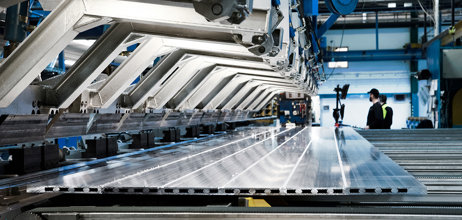
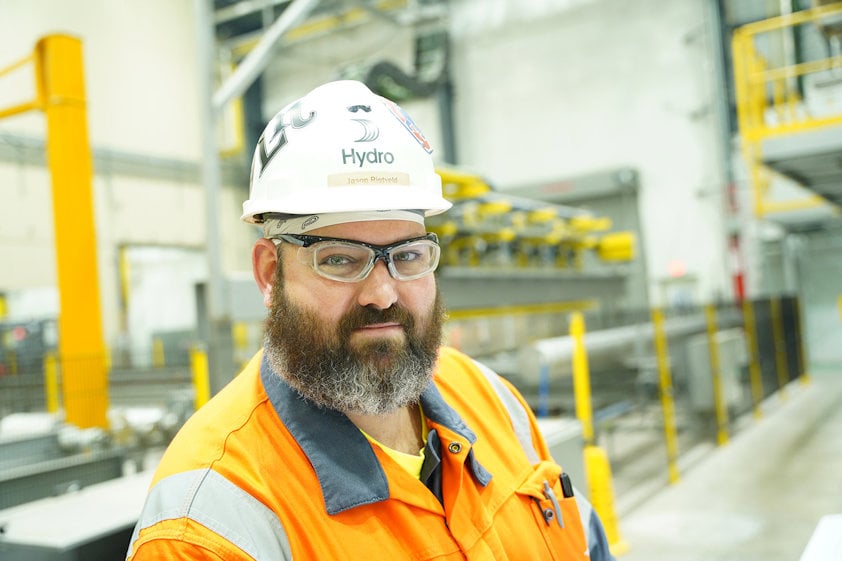
Jason works in final finishing, the last stop before the aluminium leaves Cassopolis for customers. As an acting saw trainer, he helps train operators, supports maintenance and process improvements, and works with the team to make sure products are cut and marked to the customer’s specifications.
For Hydro CIRCAL, the company’s aluminium made with at least 75 percent post-consumer scrap, that has included helping plan homogenization cycles, cutting the logs and running trials to make sure the laser system provides the required markings.
Every step depends on the one before it. And somebody else is depending on Jason and his colleagues to get theirs right.
“This is teamwork and organization work. We cannot have any bottlenecks, so we all need to work together. From the scrap buyers, management, safety, quality, the packing station and out to the customers,” says Jason.
Customer provides significant vote of confidence
General Motors (GM) recently selected Hydro CIRCAL produced in Cassopolis for the front bumper system of the Cadillac OPTIQ. The aluminium will be used in a structural crash management component behind the vehicle’s visible bumper cover, an application that must meet demanding automotive requirements for strength, energy absorption, corrosion resistance and formability.

For Jason, the announcement connects a major automotive customer with something much more familiar: people showing up every day and doing their part.
Wanting the team to win
Long before Jason worked with saws, lasers and automated production equipment, he learned about relying on other people on a baseball field.
He grew up playing sports and eventually became a college baseball pitcher. Practices could run four to six times a week, sometimes twice a day. There were drills to repeat, skills to sharpen and teammates who depended on one another.

“You’re dedicated, working hard, running drills, staying mentally focused and always trying to improve. The camaraderie and teamwork are essential to me,” says Jason.He sees much of the same dynamic on the shop floor in Cassopolis. If someone asks him how to do something, he offers a suggestion. If it doesn't work, they reconsider it and try something else. Improvement comes through repetition, learning from one another and refusing to assume yesterday's way of doing something is necessarily tomorrow's best way.

“I feel like that’s where my work ethic comes from. Striving to be better, doing a good job and ultimately wanting the team to win,” emphasizes Jason.

Jason once thought that team might be on a baseball field, but during college, his pitching arm changed those plans.
“I’ll never forget the moment when I was pitching in a game and suddenly heard and felt a snap,” he says.
He needed surgery. After rehabilitation, he tried to come back, but his arm never felt the same. Jason talked with his father, who had coached him through much of his childhood, and decided to leave school and start working. Factory work was initially simply a way forward. Then he discovered something about himself.
Machines made sense to him. CNC equipment, lasers, computers, automated systems and heavy machinery came naturally. He started at the bottom in his first factory job and worked his way into management within a few years.
Years later, news began spreading around southwest Michigan that Hydro was building a new aluminium recycling plant in Cassopolis. Jason's wife was the one who pushed him to apply.
Starting again in Cassopolis
Jason joined Hydro as a saw operator and traveled to Hydro’s recycling plant in Commerce, Texas, for hands on training.

He liked the pace. More importantly, he liked learning from the people around him.
“The training was one of the best experiences of my life,” he says.

Back in Cassopolis, he began taking on work beyond his original responsibilities. Maintenance, training and looking for ways to improve the process. Eventually, the plant created an acting saw trainer role to make better use of that knowledge.
For Jason, training isn't about being the person in the room with all the answers. It is about making the group more capable. That, too, comes from sports.
“If someone asks me how to do something, I’ll offer suggestions. If that doesn’t work, we re-evaluate and try again,” explains Jason.
There is another lesson Jason learned the harder way. Years after his baseball injury, he injured his other shoulder while trying to lift something heavy. A crane was available, but Jason was in a hurry. He had always been the “big guy” people could count on to lift things.
This time his arm gave out. The injury required another surgery and rehabilitation. It also changed how he approached work.

“Now, I stop and think: Is there an easier way? Can I use a tool instead? What are the consequences of doing it the hard way?” he asks himself.
It is a small example of the mindset he now brings to Cassopolis. Don't do something a certain way simply because you can. Look at the process. Learn from what happened. Find a better way.
From scrap to a Cadillac
That mindset becomes increasingly important as the Cassopolis plant takes on demanding products and customers.
Hydro built the plant to turn aluminium scrap that has already lived a useful life, material from products such as old vehicles, windows, doors and electrical cables, back into high quality aluminium.
Making that circular system work at industrial scale requires technology. It also requires dozens of people to execute their part of the process, every day.

A scrap buyer's decision affects what enters the plant. Operators need to keep the process running. Maintenance has to keep equipment available. Safety and quality requirements have to be met. The metal must be cast and heat treated correctly. Jason's team has to finish it to specification. Packing has to get it ready to leave.
Then another company takes over. For the Cadillac OPTIQ, Hydro supplies the recycled aluminium, Shape Corp. engineers and assembles the front bumper system to GM specifications, and GM integrates it into the vehicle.
It is a long chain. Jason only controls one part of it. That's precisely the point.
For a customer such as GM to put recycled aluminium from Cassopolis into a safety critical part of a vehicle, every link in that chain has to be able to rely on the next one.
Jason learned that principle years ago, standing on a pitcher's mound.
Today, his field looks different. But the objective hasn't changed much.

Do your job. Help the person next to you get better. Keep practicing. Look for the next improvement.
And give the team a chance to win.