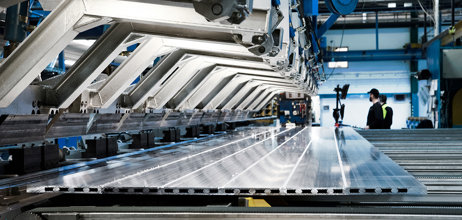
Hydro manufactures extruded aluminum busbars, tubular conductors, and flat wire profiles for OEMs and panel builders. Aluminum offers strong electrical conductivity at roughly half the weight of copper, with built-in corrosion resistance and full recyclability.

Hydro supplies aluminum conductor solutions for OEMs, panel builders and electrical equipment manufacturers, including busbars, tubular conductors and flat wire.
Specifications can be configured around alloy and temper, conductivity targets measured in % IACS, dimensions, delivery lengths, surface finish, tolerances and packaging. Hydro can also support cutting, drilling, punching, bending, machining and kitting to simplify installation.
Many conductor solutions are based on extruded aluminum profiles, allowing electrical performance and mechanical function to be designed together. An extruded busbar or tubular conductor can be adapted to the geometry, surface area and connection points of the equipment.
Hydro manufactures busbars and aluminum conductor profiles across multiple countries, in both Europe and North America.
For many busbar and conductor applications, aluminum offers a practical alternative to copper. The decision to substitute depends on current requirements, connection design, available space, and total cost of ownership. Hydro helps OEMs and panel builders evaluate the switch and design aluminum conductor solutions that meet their electrical and mechanical targets.
| Point to evaluate | What to consider |
|---|---|
| Electrical sizing | Aluminum is less conductive than copper by volume, so an aluminum busbar normally needs a larger cross-section for the same current rating. This should be checked early in space-constrained cabinets, switchgear and enclosures. |
| Weight | Even with a larger cross-section, aluminum conductors are typically much lighter than copper equivalents. This can reduce load on support structures and simplify handling and installation. |
| Thermal performance | Aluminum conducts heat efficiently, helping temperature differences equalize across the profile. Hollow or extruded busbar designs can also increase surface area and support heat dissipation in enclosed spaces. |
| Connection design | Aluminum-to-aluminum and aluminum-to-copper joints require correct surface preparation, hardware and torque values. This is often the most important engineering point in substitution projects, and Hydro can advise on joint design. |
| Fabrication | Aluminum busbars and conductor profiles can be cut, drilled, punched, machined, bent and supplied in customer-specific lengths or kits. Bending and forming depend on the right alloy, temper and bend radius. |
| Corrosion resistance | Aluminum forms a natural oxide layer that protects the surface in many indoor electrical environments. For outdoor or more demanding environments, surface treatment or coatings may be specified. |
| Cost | Aluminum is typically less expensive per kilogram than copper, but the final business case depends on the full system design, including profile size, joints, supports, fabrication and installation. |
| Recyclability | Aluminum is fully recyclable without loss of material properties, supporting circular material flows and lower-carbon product design. |
Aluminum is not a direct like-for-like replacement for copper in every design. The right choice depends on available space, current rating, connection design, installation requirements and total system cost.
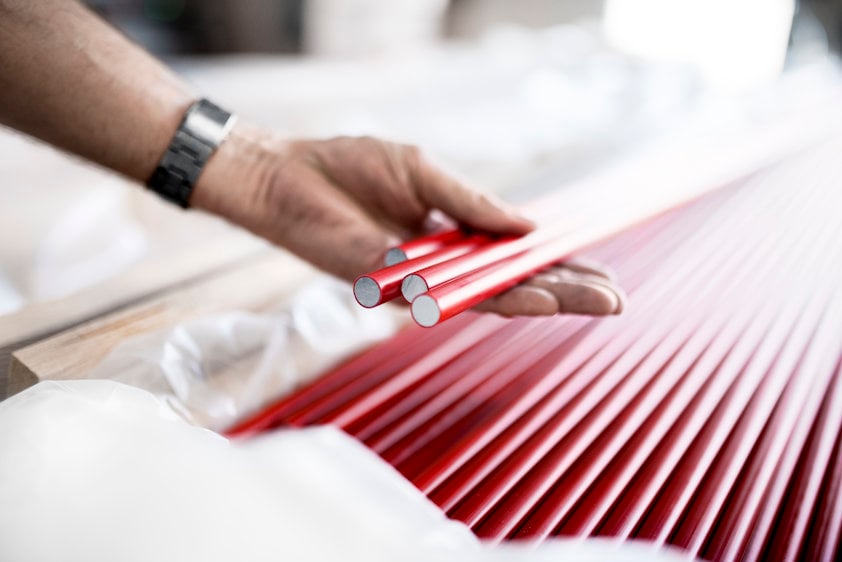
Aluminum busbars, tubular conductors and flat wire are used in electrical systems where current carrying capacity, weight, thermal performance and efficient assembly are important design factors.
Alloy selection is important for aluminum busbars, tubular conductors and other extruded electrical conductor profiles. The right alloy depends on the required balance between electrical conductivity, mechanical strength, formability, contact performance and extrusion efficiency.
High-purity 1xxx aluminum alloys, such as EN AW-1050 and EN AW-1370, are used where electrical conductivity and low weight are the main priorities. These alloys offer high aluminum purity and good corrosion resistance, and can be extruded into profiles, rods, bars and tubes for conductor applications.
For applications that also require higher strength or improved contact performance, EN AW-6101A/B can be a good option. This Al-Mg-Si alloy has slightly lower conductivity than 1xxx alloys, but offers a stronger balance of conductivity, mechanical performance and manufacturability.
Compared with Cu-ETP R220 copper, aluminum conductor alloys have lower conductivity by volume but much lower density. In practice, this means an aluminum busbar usually needs a larger cross-section than copper for the same current rating, but the finished conductor can be significantly lighter.
| Alloy / material | Typical role in conductor applications |
|---|---|
| EN AW-1370-H112 | High-conductivity aluminum alloy for busbars and conductor profiles |
| EN AW-6101-T7 | Balanced conductivity, strength and contact properties |
| EN AW-6101-T6 | Higher strength option where mechanical performance is important |
| Cu-ETP R220 | Copper reference material with high conductivity but higher density |
Hydro can help select the right aluminum conductor alloy and temper based on conductivity targets, profile geometry, mechanical requirements and production needs.