When you choose aluminium from Hydro, it's strong, light, durable and climate efficient, making you part of a smarter and more sustainable future. Our climate strategy is to cut our CO2 emissions 30% by 2030. Our aluminium can help you meet your goals, too.
Energy
Hydro has been at the forefront of the energy transition since 1905, transforming industries and societies with renewable energy. Today, we are pioneering the green aluminium transition through renewables and new energy solutions.
Sustainability
We want to contribute to the just and green transition through responsible production, creating circular solutions and delivering net-zero aluminium by 2050 or earlier.
Careers
At Hydro, we put our people at the center of everything we do. By supporting our employees’ growth professionally and personally, we are fostering a community of colleagues who are united in the shared purpose of solving our industries’ most pressing challenges.
Investors
With more than a century of industrial experience, we are enabling the green transition through innovation, technological advances, and a strong commercial mindset.
Media
Working on a story about aluminium? Press releases, photos, stories, facts and figures – you will find everything you need here.
About Hydro
Hydro is a leading aluminium and renewable energy company that builds businesses and partnerships for a more sustainable future. We have 32,000 employees in more than 140 locations and 40 countries.
Efficient Thermal Management with Aluminum Heat Sinks
Thanks to its high thermal conductivity, aluminum is ideal for heat sinks, as it can be shaped into the desired application profiles more easily than copper.
We can add value to your heat sink solutions by enhancing thermal performance in both small and large heat sinks. We know from experience that the improved thermal performance you gain in your heat sinks by using aluminium extrusions often leads to less weight, higher efficiency, and a lower total cost.
Electronic components generate heat during operation. Excessive heat can have serious consequences, such as limited or reduced performance, temporary or permanent changes in component properties, or the destruction of components.
Optimal performance in a targeted temperature range is crucial. To achieve this and to maximize the life and performance of the product, we offer a variety of cooling solutions.
Designing aluminium heat sink solutions
Top-quality aluminium heat sink solutions do not have to be expensive. The math is simple: In the design phase, you can achieve cost reductions of more than 50%, while in the purchasing phase, only margins can be reduced.
It makes good sense for you to utilize our material specialists and engineering experts during an early stage of your design and development needs. They can provide design advice and give alternatives for alloys and surface treatment.
Allowing our experts to propose an idea for your first hesitant beginnings of a new heat sink design results in a clear picture. This identifies the potential improvement from using advanced thermal analysis and complex product simulations. With these services we can identify further options for:
Reducing material content
Delivering optimized sections
Proposing simplified assembly and adding more fabrication options
In addition to cooling, you have the opportunity to integrate other functionalities when you use aluminium extrusions. These include:
Screw ports
Cable channels
Features for fastening – and for faster assembly
We can also optimize air-cooled heat sinks through simulation, such as fin geometry.
Surface treatment – design and function – capsule and component
In many business areas, the surface of our extruded aluminium solutions is an integral part of the design. But we also offer various surface treatments if additional coatings and protection are required.
Heat sink profile that includes different functions.
Active and passive thermal management
Active and passive thermal management are two basic approaches to controlling heat in engineering systems. The method you choose should depend on the requirements and thermal properties of the system.
Passive cooling focuses on natural convection and thermal radiation to dissipate heat. Heat is dissipated by cooling fins, coolers or similar mechanisms made of thermally conductive metal, such as aluminium or copper. These components are designed to provide a large surface area to effectively dissipate the heat of the heated product into the air.
Active cooling uses fans or pumps to circulate air through the heat sinks and thereby dissipate the thermal energy. This method is superior to passive cooling in terms of performance, resulting in faster and more effective heat dissipation.
Liquid and air cooling
We offer heat sink solutions in aluminium for liquid or air cooling. Whichever solution you prefer, there are many factors to consider, such as the choice for heat conduction.
The flow of liquid or air is what conducts, or “carries away,” the heat from your heat source. The trick is to get the flow to work hand in hand with the solid heat sink. This can be done by using a circular hole or rectangular channel throughout your liquid heat sinks or by identifying the optimal fin design for your air-cooled heat sink.
Which cooler should I choose?
There are different solutions for different dissipation needs
Air cooling
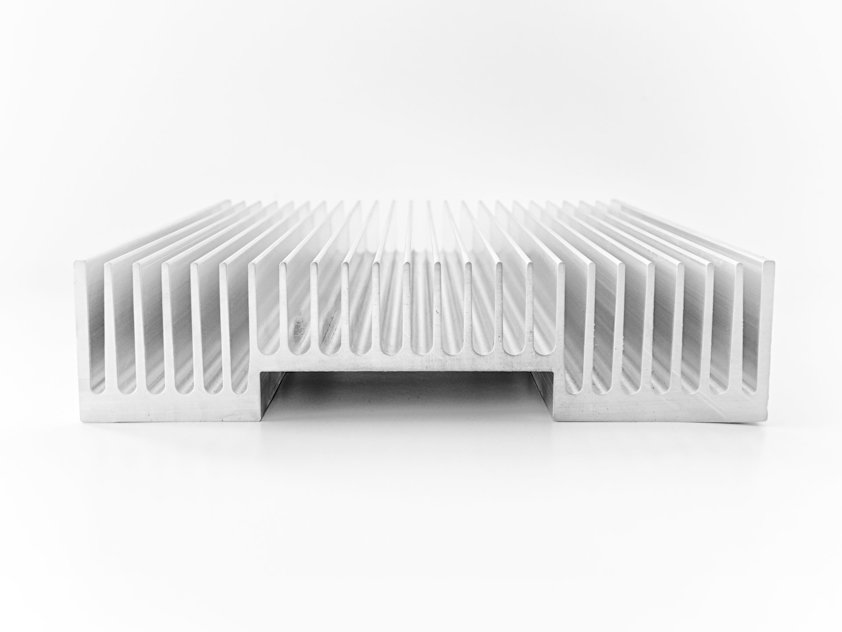
Aluminum fins are the most common components of a heat sink, which is made of extruded aluminum and is essential for heat dissipation. Their design, which varies in shape and size, aims to maximize surface area, absorb heat from the source, transfer it evenly, and efficiently release it into the environment through natural or forced convection.
Example heat sinks with a tongue ratio of 17:1 and 20:1, respectively.
Heat sink with straight fins:
The ribs and the base from which they emanate are made from a single extruded aluminum profile.
Cross-cut heat sink:
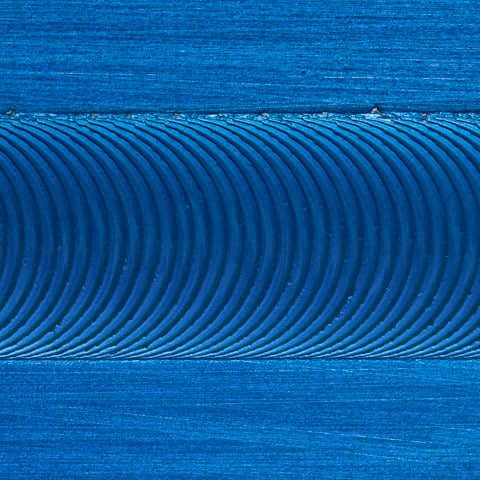
The unique swirled or curved slats and base are made from a single extruded aluminium profile.
Which Fin Design should your profile have?
A high fin ratio is often required to manage high-powered heat sinks. However, weight savings can be a challenge in such scenarios, due to the delicate balance between airflow and fin design.
For standard heat sink fin heights, there could be more weight-saving potential by designing the fin as straight vs. conical A straight fin design has a better thermal performance than a conical design and it also enables a lighter package. Whilst conical fins have a slight advantage when natural convection.
Airflow comparison between straight vs. conical fins. A straight fin design is preferred when active cooling is used. This means using a fan or blower in combination with the heat sink.
Liquid cooling
The unique possibilities of friction stir welding enable us to produce liquid coolers with outstanding performance. Liquid coolers can be designed with lower weight, lower total costs and, in many cases, improved heat-transfer performance.
By taking advantage of the extrusion process, fluid channels are incorporated into the profile eliminating the need for costly downstream operations. An optional insert extrusion forms micro channels and delivers better performance that otherwise cannot be achieved as a single piece extrusion. All of these components are then assembled and sealed together using cover plates that are friction stir welded in place to create a high performance leak-proof system. In addition, extrusion geometry is highly flexible to accommodate specific package constraints or thermal performance requirements.
Liquid heat sink with inserts. To block parts of channel to boost fluid velocity and gain more cooling effect.
With liquid cooling, circular or rectangular design could create additional value for your product.
Choosing fin design inside the hole increases surface area. An increase of surface area often results in lower temperature gradients. But because these channel designs cannot be machined, an aluminium extrusion is the best solution. Rectangular-shaped channels increase the cooling effect even more due to the larger contact area closer to the heat source.
Aluminium profiles for liquid cooling
Where can you use aluminum heat sinks?
Industrial machinery/equipment
In industrial equipment such as power supplies, customers often use aluminium extrusions for efficient heat dissipation.
Renewable energy systems
Heat sinks for solar inverters and wind turbines can use aluminium extrusions to handle thermal loads in renewable energy systems.
Luminaries/Led lighting
Aluminium extrusions are widely used in the production of heat sinks for LED lights to effectively dissipate the heat generated by the LEDs.
Telecommunication
Heat sinks in telecommunications equipment, such as data centers, routers, and base stations, can contain aluminium extrusions for effective heat dissipation.
Automotive
With the advent of electric vehicles and hybrid systems, as well as the increasing integration of advanced driver assistance systems, infotainment and other electronic functions, effective heat dissipation has become critical in the automotive industry.
Why you should use aluminium for heat sinks:
Good thermal conductivity and high thermal capacity
Lower material price and lower density compared to copper
Corrosion resistance
Robust and durable
100% recyclable material
Surface treatments available include anodization and powder coating